
Feeling at home
Attachment, attachment, identity and difficulty settling into a place.
 The quality certification was awarded for the following categories of action:
Professional training · Online
Understand the relationship between a person and their living space to support the evolution of the home with listening and method.
The path covers uses, habits, attachment and the emotions associated with places, beyond their physical or aesthetic organisation alone.
The offer with coaching
Definition
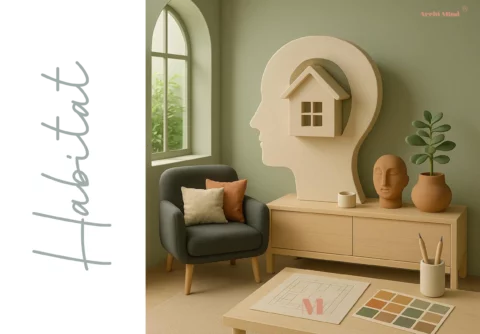
In the Archi Mind approach, Psychology of the home reads an interior as a reflection of the person living in it: their needs, their emotions, their history, the way they function, and whatever may be holding them back.
The layout, the objects, the colours and the organisation of the space all become clues to the relationship the occupant has with their living space.
Combined with Feng Shui, this reading makes it possible to identify imbalances and to act concretely on the home: supporting change, shifting certain patterns and encouraging a new personal dynamic.
Who is the training for?
These profiles are concerned depending on their activity and their professional project.
Topics studied
The path questions concrete experiences of the home and the change needs that may be associated with them.
Attachment, attachment, identity and difficulty settling into a place.
Spaces that have become unsuitable, habits, constraints and conflicts of use within the home.
Need for renewal or reorganisation during a life change described by the occupant.
Listening to how something feels and distinguishing what relates to uses, to the space, or to personal projections.
Objects, decoration and organisation as a basis for a personal, symbolic reading.
Clarifying real needs before a redesign or decoration project.
Learning objectives
The objectives favour observable actions, without promising psychological transformation.
Observe the relationship between a person, their uses and their living space.
Question the needs, habits, emotions and expectations expressed around the home.
Analyse organisation, decoration and objects as elements of the experience and attachment of a place.
Identify situations of discomfort, conflicts of use and the space’s needs for change.
Connect spatial observations to the context and the life transitions described by occupants.
Formulate development recommendations suited to the uses and the project of the person being supported.
Adopt a stance of listening, caution and respect for professional boundaries.
Intended capabilities
These capabilities do not constitute an officially certified professional skill.
Gather the uses, constraints and experience expressed around the place.
Separate observable facts, needs, feelings and interpretations.
Build recommendations suited to the context and the project.
Listen, respect confidentiality and recognise the limits of your involvement.
The programme, in detail
The topics below bring together the documented themes of the path, from the relationship to place to the professional framework of support.
Part 1 · Feng Shui Origins, the flow of Chi, Yin/Yang balance, the five elements, the Bagua
Part 2 · Psychology of the home Psyche, the symbolism of spaces, decoding, memories, assessment and posture
The bonuses Two complementary readings, opened at the end of the course
01First names in transgenerational reading
02Numerology of the home
Teaching method
The precise organisation and any live sessions depend on the published session.
Discover the AcademyProfessional applications
Clarify uses, expectations and the relationship to the home before proposing a change.
Observe organisation, objects, habits and constraints in their context.
Integrate the identity and experience expressed by occupants into the design thinking.
Listen better to the relationship to a place without producing a psychological diagnosis.
Support the clarification of a need for spatial change, within your scope of competence.
Identify tensions in use and look for an organisation more coherent with the needs expressed.
What this is not
The training does not confer the title of psychologist and does not prepare for medical or psychological diagnosis, nor for psychotherapy.
The professional stays within their field of competence, only gathers information useful to the project, and respects the confidentiality of exchanges. A situation relating to mental health must be referred to a qualified professional.
How it works
Online training with access to the content assigned in the Academy.
Input, materials, exercises, situation analyses, case studies and quizzes.
A quiz and a case study are documented. No certificate title is published without validation.
An adaptation can be discussed in advance based on needs linked to a disability.
Up-to-date information is published on the dedicated page.
See the sessionsThe student space gathers the courses and documents assigned after enrolment.
Go to the AcademyQuality and funding
Archi Mind is Qualiopi-certified for training activities. This certification is neither a personal certification for the participant, nor a scientific validation of the content, nor a funding guarantee.
Depending on your situation, funding support can be discussed with your employer, an OPCO or as part of a skills development plan. It depends on the scheme, the file and the funder’s agreement. Trainings are not currently eligible for CPF funding.
The essentials
Prices are those of the shop, and follow it automatically.
None
12h of training
12h of live mentoring
€1,690.00 (with coaching)
€1,090.00 (self-paced)
Check the announced dates before requesting enrolment.
See the sessionsContact Archi Mind to discuss possible adaptations.
Contact Archi Mind
The trainer
After experience in real estate, Mathilde Morel trained in interior decoration, neuro-architecture, and the psychology of colours and of the home.
With Archi Mind, she connects design practice to listening to the needs, uses and experience expressed around places.
Discover her backgroundSpecific FAQ
The answers explicitly distinguish the analysis of the home from the practice of psychology.
See the general FAQPsychology of the home first looks at the subjective relationship between a person and their living space: identity, attachment, emotions, habits and attachment. Neuro-Architecture more directly addresses perception, cognition and the sensory characteristics of the built environment.
No. The historical training is aimed at professionals who want to bring a human, emotional reading to the home. It does not, however, train people in the clinical practice of psychology.
No. The sources mainly cite interior architecture, decoration and home professionals. A prior conversation lets you check whether the path suits another activity or a career-change project.
These concepts can enrich how you listen to uses and understand the relationship with a home. Their use must stay within the professional’s scope of competence and must not become a psychological diagnosis.
No. This training does not confer the title of psychologist and does not allow you to practise clinical psychology or psychotherapy.
The sources confirm an online path including input, materials, exercises, situation analyses, case studies and quizzes. The up-to-date organisation depends on the session chosen.
After enrolment, the necessary information is sent to activate the student space and view the assigned content.
Depending on your situation, funding support can be discussed with your employer, an OPCO or as part of a skills development plan. It depends on the scheme, the file and the funder’s agreement. Trainings are not currently eligible for CPF funding.
Contact Archi Mind before enrolling to discuss your needs and explore possible adaptations for the session concerned.
After certification
At the end of this training you can appear in the Archi Mind directory: a map where people search by town, and discover how you work before contacting you.
Your next step
Find published information or ask your questions before enrolling.