

Psychology of the home
Home, identity and emotions: what our interior says about us
An interior carries traces of choices, habits and relationships. It can express belonging, preserve memories, or accompany a new stage of life. This does not, however, make it possible to infer an occupant’s personality from their decor. The most accurate reading relies on what the person says about their place and how they use it.
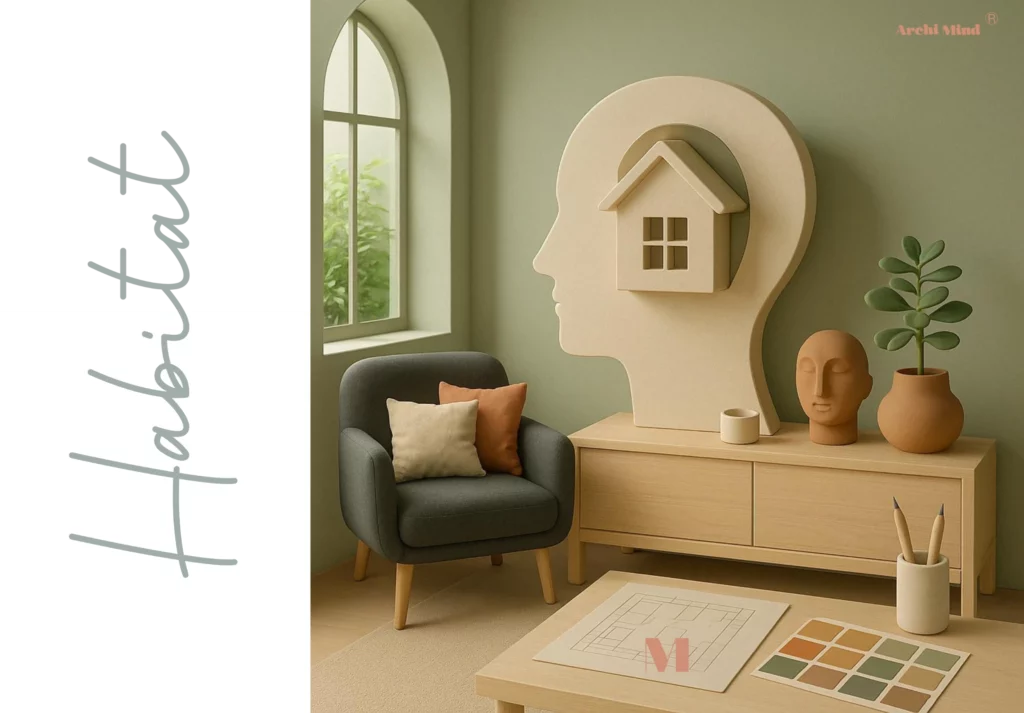
Identity is not just a decorating style
Style categories make it easier to search for images, but they poorly describe the complexity of a home. The same interior can combine an inherited piece of furniture, a recent artwork and a highly functional solution. This coexistence often says more than strict adherence to a trend. It reflects timelines, ties and successive decisions.
A project can therefore look for coherence without erasing differences. A palette, a recurring material, or a more legible organisation can connect heterogeneous elements. Coherence becomes a welcoming framework, not a requirement for uniformity.
Objects as carriers of memory and use
An object can have practical, aesthetic or biographical value. Before recommending its removal, it is useful to understand its role. Some objects support continuity after a change; others simply remain by default and get in the way of an activity that has become a priority. Only the person concerned can clarify that value.
Staging it visibly is not the only option. Accessible storage, rotation, or a photograph can sometimes preserve the memory while freeing up space. The decision benefits from being gradual, especially when it touches on an inheritance or a sensitive period.
Sharing a place, negotiating several identities
In a shared home, everyone needs to be able to recognise a part of themselves. Decorating tensions sometimes mask a question of territory, decision-making or visibility. Defining shared zones, personal spaces and rules for choices makes the dialogue more concrete.
Balance does not require perfect symmetry. It depends on the time spent, the activities and everyone’s needs. One person may need a closed space to work, another a surface to create. The project must make these needs as compatible as possible.
Life transitions and the transformation of decor
Life events change the relationship to the home. A departure, a birth, a new job or reduced mobility can make certain layouts unsuitable. Transforming a room can help give shape to the new organisation, but the pace of change should remain a choice.
An inventory of what to keep, move, pass on or replace makes it possible to separate the emotional decision from the spatial one. This method avoids trying to solve everything in a single session and makes a step-by-step project easier.
A reading that respects professional limits
No single object reveals a psychological trait on its own. Automatic interpretations risk projecting the consultant’s own references onto the occupant. A responsible practice forms open hypotheses, asks for confirmation, and accepts that a choice may have no justification beyond taste or convenience.
This stance is at the heart of a psychology of the home distinct from clinical psychology. It can enrich how a design project listens, without replacing therapeutic support. The framework of the Archi Mind training makes this distinction explicit.
In conclusion
Our interior mostly tells the story of a relationship in motion between people, objects and uses. Listening to it requires curiosity and caution. When several needs must be reconciled in a project, the Services page helps choose the right level of support.